
Imagine you’re in a leadership meeting and someone asks, “Which projects should we fund this year?”
Five minutes later, the conversation has somehow shifted to which applications to retire, which vendors to renegotiate, and why the company is still paying for three tools that do essentially the same thing.
Everyone is talking about the “IT portfolio.” But are they actually talking about the same thing? Not quite.
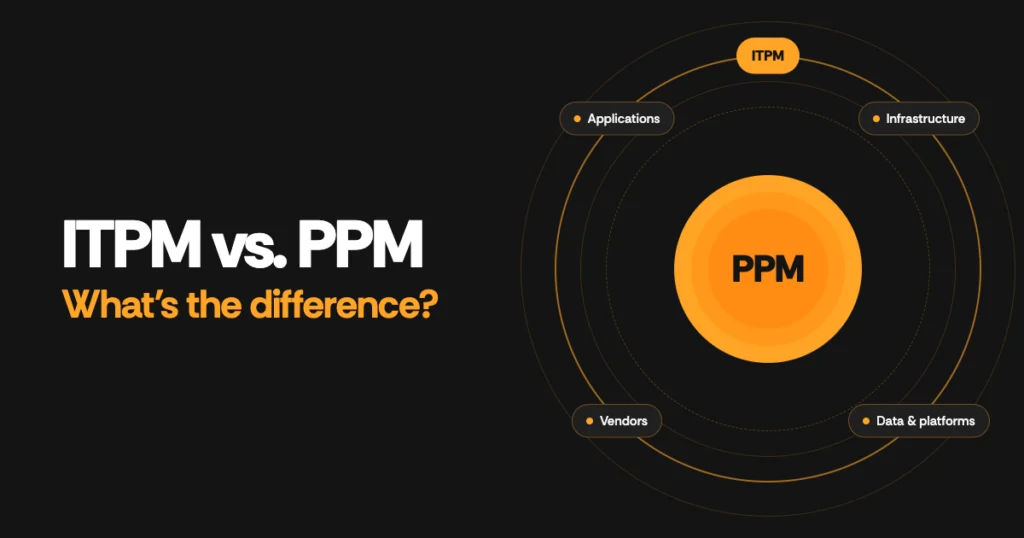
Project Portfolio Management (PPM) and IT Portfolio Management (ITPM) are closely related, which is exactly why they’re so often confused. They may use similar terminology, appear together in software platforms, and even overlap in some organizations. But they focus on different decisions.
In short:
Project Portfolio Management (PPM) asks: Which projects and initiatives should we invest in?
IT Portfolio Management (ITPM) asks: Across everything we own and invest in across technology, what is delivering value, what is creating cost or risk, and what should we change?
The difference shapes how organizations decide where to invest, what to prioritize, what to keep, and what to stop.
In this article, we’ll define PPM and ITPM in plain English, walk through an example, explain where they overlap, and show when to use each one.
What Is Project Portfolio Management (PPM)?
Project Portfolio Management is the practice of managing a group of projects as a single portfolio, rather than approving and tracking them one at a time. The Project Management Institute (PMI) defines portfolio management as the centralized management of one or more portfolios so that executives can make efficient decisions across projects, programs, and operations in service of organizational goals.
In plain terms: a company that’s running twenty different initiatives like a new CRM rollout, a security upgrade, a market expansion and an AI pilot simultaneously can’t evaluate them fairly in one meeting. PPM pulls all twenty into a single view so leaders can compare them side by side on things like:
- Business value: what is the cost and expected return on investment (ROI)?
- Strategic alignment: does this project support the company’s strategic goals?
- Risk: what could derail it, and what’s the impact if it does?
- Resource load: do we have the people and budget to do this and everything else on the list?
PPM connects an organization’s strategy to the individual projects meant to carry it out. Its main concern is choosing which projects to run so the portfolio as a whole supports that strategy, rather than how well any single project is managed.
What Is IT Portfolio Management (ITPM)?
IT Portfolio Management takes a similar “manage it as a group, not one at a time” approach but applies it to the company’s entire technology footprint: active projects plus everything already running.
According to the Project Management Institute, IT portfolio management is the discipline of managing IT investments as you would a financial portfolio, balancing potential return, fit with objectives, and risk assessment, and it enables organizations to establish a formalized process for measuring and monitoring the value of those investments. The discipline started project-focused but has since expanded to include steady-state items like the applications, infrastructure, and systems a company keeps running day to day, long after any related project has ended.
In plain terms: a company that’s been running for a decade might have twenty active projects, along with forty applications, a dozen infrastructure contracts, and a handful of tools three different teams bought to solve the same problem. No one can evaluate that pile fairly by looking at it project by project, because most of it isn’t a “project” anymore; it’s just running in the background, still costing money.
That’s the core of ITPM. It typically covers:
- The project portfolio: same as PPM, the active initiatives
- The application portfolio: every piece of software the company runs, and whether it’s still earning its keep
- Infrastructure and vendor contracts: servers, licenses, cloud spend, renewals
- Risk and compliance exposure: outdated systems, security gaps, redundant tools
A good way to think about it: PPM and ITPM overlap, but they focus on different stages and perspectives of technology investment. Every project eventually either dies or graduates into something the company runs permanently. That permanent “something” is exactly what ITPM is built to track, long after the project team has moved on.
IT Portfolio Management vs. Project Portfolio Management: A Side-by-Side Look
| Project Portfolio Management (PPM) | IT Portfolio Management (ITPM) | |
| What it covers | Active projects and initiatives | Projects, plus applications, infrastructure, and ongoing IT operations |
| Core question | Are we doing the right projects? | Is our entire technology estate delivering value? |
| Time horizon | Short to mid-term: the life of a project | Long-term: the life of a system, sometimes years |
| Primary owner | PMO leader, program manager | CIO, IT leadership |
| What “success” looks like | Projects delivered on time, on budget, aligned to strategy | Reduced redundancy, lower risk, technology spend matched to business value |
This lines up with how most independent sources frame it: ClickUp’s comparison describes PPM as focused on project alignment, prioritization, and timely delivery, while ITPM is framed around long-term IT strategy and reducing risk and redundancy across all of an organization’s technology. Same instinct to manage things as a portfolio, not a pile, but applied at two different altitudes.
An Example from Retail
Say a mid-size retailer decides to build a new online store. That’s a project that has a start date, a budget, a team, and an end date when the site goes live.
PPM’s job, before that project even starts: comparing it against everything else competing for the same budget that year, like a warehouse automation initiative, a new point-of-sale system, a CRM migration, and deciding to fund the online store over, say, delaying the warehouse project. PPM’s job while it’s underway: keeping it on budget and on schedule, and checking that it still justifies its cost compared to the other initiatives running at the same time.
Then the site goes live. The project team disbands, the launch gets celebrated, and everyone moves on to the next thing. But the online store itself doesn’t stop existing; it still needs to be patched, secured, scaled for Black Friday traffic, integrated with the warehouse system, and eventually replaced in a few years. That ongoing life is ITPM’s job, not PPM’s.
The project PPM once tracked has “graduated” into an asset that ITPM now manages indefinitely, right alongside every other application, server, and vendor contract the retailer already owns. Put simply: PPM manages the sprint. ITPM manages everything still standing after the sprint ends.
Where They Overlap and Why You Need Both
The confusion is understandable; the two overlap and interact to guide technology investment decisions. A project funded through PPM eventually creates, upgrades, or replaces something that becomes part of the broader IT portfolio. Some newer agentic platforms also combine project, application, infrastructure, and financial data in one system, making the two disciplines appear interchangeable.
IT projects are especially prone to scope creep, budget pressure, and resource constraints. In Tempo’s 2026 State of SPM report, planning and PMO leaders said their biggest execution challenges were deciding which projects to prioritize and how to allocate people, and almost one in three projects (30%) wasn’t delivering meaningful ROI or strategic value. PPM addresses this at the project level by forcing trade-offs and prioritization.e.
That’s why having one without the other creates a blind spot. A company can run disciplined PPM, pick the right projects, and deliver them well, and still end up with a bloated, expensive set of applications, because nobody evaluates what happens after launch. Or it can have excellent ITPM visibility into its applications and infrastructure, but no structured way to decide what gets funded next. Either way, the result is the same: initiatives approved in isolation, tracked in scattered spreadsheets, with nobody able to say what any of it actually returned.
The problem reaches beyond the IT department. In Protiviti’s 2026 Global Transformation Survey of 852 executives, 61% of CIOs and CTOs said they were confident in their transformation outcomes, compared with only 34% of CEOs and boards. Finance leaders feel the gap too: in a July 2026 Avalara survey, 92% of CFOs and senior finance executives said they’re under pressure to prove their AI investments are paying off, and half said their AI agents had produced only limited measurable returns. When leadership can’t agree on what success looks like, it gets harder to fund initiatives, keep spend on budget, and decide what to stop.
Together, these point to a broader challenge: choosing the right investments is only half the equation. Organizations also need visibility into what those investments become, what they cost over time, and whether they continue to deliver value.
The Deeper Issue: A System of Record vs. A System of Work
Here’s the part most articles on this topic skip: whether you call it PPM, ITPM, or both, most of the tools built for either category are fundamentally systems of record. They’re good at storing project status, budget lines, and application inventories, and later showing it back to you in a dashboard. What they don’t do is act on any of it. Someone still has to manually chase status updates, reconcile numbers across three tools, and rebuild the board deck by hand every quarter.
A system of work, by contrast, stores the portfolio and runs it. It plugs into the tools a team already uses, actively helps match people to the initiatives that need their skills, flags risk before it becomes a crisis, and can show, with actual figures, what each dollar of transformation spend actually returned instead of everyone taking it on faith.
AI transformation is a good example. Most organizations are still working out where AI fits, which use cases to fund, and which pilots should scale or stop. The initiatives, the tools, and even the definition of success are shifting month to month, and that will likely continue for some time. A static system of record can only capture a snapshot of that work, and the snapshot is out of date almost as soon as it’s saved. A system of work keeps pace with it: it tracks AI initiatives as they evolve, moves people as priorities shift, and shows which investments are producing results so leaders can double down or cut their losses with confidence.
This is the gap Trmeric was built to close. Rather than adding one more dashboard on top of an already fragmented set of tools, Trmeric puts agents at every stage of IT portfolio planning to help determine where the value actually is, mobilize teams and partners, keep execution on track, and attribute ROI as it happens. So leadership isn’t reconstructing the story after the fact. Expect this distinction to come up often as more of this category shifts from passive tracking toward something that actually does the work of running the portfolio.
FAQ
Is IT portfolio management the same as project portfolio management?
No. PPM manages a company’s active projects as a group. ITPM is broader — it manages the full technology estate, including projects, but also the applications, infrastructure, and systems that keep running long after a project ends.
Which one does a CIO typically own?
ITPM is usually owned or sponsored by the CIO or a Chief Transformation Officer, since it spans the entire technology footprint. PPM is often run day-to-day by a PMO leader or program manager, though it reports up to the same leadership.
Do I need both PPM and ITPM software?
Not necessarily as two separate tools — many modern platforms handle both, since a project’s outcome (a new application, a retired system) is exactly what ITPM needs to track next. What matters more than the label is whether the tool actually connects the two, rather than treating them as separate spreadsheets.
What’s the biggest risk of getting this wrong?
Approving projects without visibility into the systems they’ll become, or tracking IT assets without a disciplined way to decide what gets funded next. Either way, the common failure pattern is the same: work tracked in disconnected tools, with no reliable way to prove what any of it returned.